
DISCOVER UGANDA’S PREHISTORIC SITES
Before Uganda today, people walked this land. They painted on rock walls, chipped stone tools, and built earthworks that still defy time. Uganda’s prehistoric sites are not just old places. They are memory banks. They hold the first chapters of human resilience, creativity, and survival in East Africa. While gorillas and safaris pull the crowds, these silent sites hold the story of who we were and who we can still become.
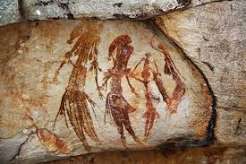
Deep in eastern Uganda, Nyero’s granite shelters carry red, white, and black paintings over 3,000 years old. Concentric circles, canoes, and geometric patterns tell us that early communities here had ritual, trade, and art. It’s one of Africa’s best-preserved rock art galleries, and you can still see the pigments the first artists left behind. Local legend links the site to spirits, but archaeology links it to Batwa hunter-gatherers and later pastoral groups.
The Nyero Rock Paintings
Dolwe Island on Lake Victoria
Off the shores of Buvuma, Dolwe Island holds rock art and grinding grooves carved into stone. The paintings here are older and more weathered than Nyero’s, showing how widespread early expression was across the Lake Victoria basin. Fishing communities, island isolation, and stone shelters made Dolwe a perfect canvas for prehistoric life.
Dolwe island
Fort Patiko, Gulu District
Also called “Gordon’s Fort”, this 19th-century mud-and-stone fort in Acholi land marks a different kind of “prehistoric,” early colonial contact period. Built around 1872 under Charles Gordon’s administration, it was a base during anti-slavery operations. The walls, gun emplacements, and ruins show how foreign presence collided with local societies just as archaeology was beginning to document deeper time.
Wadelai & Dufile Forts, Emin Pasha & Charles Gordon’s Frontier
On the West Nile frontier, Wadelai and Dufile forts were key outposts in the 1870s-1880s. Emin Pasha, the governor of Equatoria Province, and Charles Gordon both operated here during a time of exploration, conflict, and trade. The ruins reveal mud walls, wells, and remnants of a colonial world pushing into the African interior. They are not Stone Age, but they sit on landscapes that were occupied by humans for thousands of years before them. Layers of history are just stacked on one another.
Other Prehistoric Sites in Uganda
Uganda’s timeline does not stop here. Across the country, you will find more pieces of the puzzle, such as Bigo Bya Mugenyi in Sembabule, with evidence of massive Iron Age earthworks, Nsongezi Rock Shelter in Mbarara with evidence of Stone Age tools and occupation layers, and Magosi in the northwest, indicating some of Uganda’s oldest stone tool shelters with occupation debris. Each adds a line to Uganda’s deep human story without needing excavation to feel its weight.
A pictorial view of Nyero Rock Art
Guardians of the Past: Department of Museums & Monuments
The Department of Museums and Monuments, based at the Uganda Museum in Kampala, holds the legal mandate. Under the Ministry of Tourism, Wildlife & Antiquities, they are tasked with identifying, documenting, conserving, and gazetting heritage sites nationwide. From surveying new rock art to fencing vulnerable sites and working with local communities, their team is the quiet custodians keeping these places from vanishing.
You do not have to explore this history alone. chimptrails.com is ready to take you to these historic places. Whether you are a researcher digging for data, a student tracing human origin, or a visitor chasing meaning beyond the usual safari, our expertise lies within your needs to give you a memorable experience. We handle the routes, the permits, the local guides, and the stories that bring the stones to life.