
DISCOVER UGANDA’S PREHISTORIC SITES
Long before modern Uganda emerged, people inhabited its landscapes, painted on rock walls, crafted stone tools, and built earthworks that have endured for centuries. These sites preserve stories of human resilience, creativity, and survival in East Africa.
While Gorilla trekking and wildlife safaris attract visitors from around the world, Uganda offers another remarkable experience: exploring its ancient human heritage.
Nyero Rock Paintings: Ancient Rock Art in Uganda
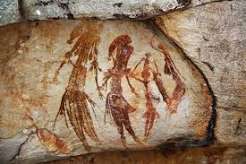
Located in eastern Uganda, the Nyero rock shelters preserve remarkable paintings in red, white, and black. Researchers associate these artworks with ancient hunter-gatherer communities. Concentric circles, geometric patterns, and other figures reveal the artistic traditions and cultural practices of the people who once lived here.
Nyero is one of East Africa’s most significant rock art sites. Visitors can explore its shelters and observe the surviving pigments and patterns. These artworks connect us to generations of early artists and their ways of life.
Local traditions also associate the site with spiritual significance. Meanwhile, archaeological research continues to investigate its connections with past hunter-gatherer and pastoral communities.
Dolwe Island
On Lake Victoria, Dolwe Island offers another fascinating glimpse into Uganda’s ancient heritage. Its weathered rock surfaces preserve rock art and grinding grooves, providing evidence of past artistic expression and stone-working activities.
The island reveals how early communities interacted with their natural environment. Its rock shelters and lakeside setting also offer valuable opportunities to explore ancient cultural traditions across the Lake Victoria basin.
Together with Nyero, Dolwe enriches our understanding of the region’s rock art. Both sites encourage visitors and researchers to explore the history of human settlement and artistic expression in East Africa.
Fort Patiko
In northern Uganda’s Gulu District, Fort Patiko, also known as Gordon’s Fort, preserves the remains of a nineteenth-century military and administrative outpost. Charles Gordon’s administration established the fort around 1872. It later became associated with colonial activities, exploration, and anti-slavery campaigns in the region.
Today, visitors can examine the surviving stone and mud structures. These remains offer insights into the fort’s military role and the interactions between foreign administrators, traders, Acholi communities, and other local societies.
Although Fort Patiko is not prehistoric, it adds an important historical dimension to Uganda’s heritage. It shows how colonial-era developments intersected with the much longer history of human occupation in northern Uganda.
Wadelai and Dufile Forts: Tracing Emin Pasha and Charles Gordon’s Frontier
Further north, along Uganda’s West Nile frontier, Wadelai and Dufile preserve important traces of nineteenth-century exploration, administration, trade, and conflict. Their histories are linked to the activities of Charles Gordon and Emin Pasha in the wider Equatoria region.
At Dufile, visitors can explore the remains of a fortified settlement associated with Emin Pasha’s administration. Wadelai also forms part of this frontier history, reflecting the political and military developments that shaped the region during the late nineteenth century.
These sites connect Uganda’s landscapes to wider historical events. Although they are not Stone Age sites, they help illustrate how successive generations occupied, travelled through, and transformed the region before and after colonial contact.
Other Archaeological Sites to Discover in Uganda
Beyond its famous rock art and historic forts, Uganda has many other sites that reveal its rich archaeological heritage. These locations preserve evidence of ancient settlement, technological innovation, and changing ways of life.
Bigo Bya Mugenyi: Uganda’s Ancient Earthworks
Explore extensive earthworks and ditches associated with past settlement and political organisation. The site reveals how communities reshaped their surroundings and developed complex social systems.
Nsongezi Rock Shelter, Southwestern Uganda
Discover an important archaeological site where researchers have documented Stone Age tools and evidence of past human occupation. Its archaeological deposits help reconstruct how early communities lived and adapted to their environment.
Magosi, Northeastern Uganda
Explore an archaeological landscape associated with early stone-tool traditions and past human activity. The site contributes to our understanding of ancient settlement and technological development in the region.
Together, these sites reveal different aspects of Uganda’s long human story. They show how people made tools, occupied shelters, modified landscapes, and adapted to changing environmental and social conditions. Each location offers another piece of the archaeological puzzle, inviting visitors to look beyond Uganda’s famous wildlife attractions.
Protecting Uganda’s Archaeological Heritage
Uganda’s archaeological heritage requires active protection, careful research, and strong community participation. The Department of Museums and Monuments, under the Ministry of Tourism, Wildlife and Antiquities, leads efforts to identify, document, conserve, and protect the country’s heritage sites.
Through archaeological surveys, documentation, and conservation initiatives, heritage professionals work with local communities to safeguard these irreplaceable resources. Their efforts help preserve rock paintings, archaeological deposits, ancient earthworks, historic structures, and other cultural treasures for future generations.
Visitors also have an important role to play. By following site regulations, respecting local customs, avoiding damage to rock surfaces and archaeological remains, and engaging knowledgeable local guides, travelers can support conservation efforts. Every responsible visit helps protect Uganda’s past.
Explore Uganda’s Ancient Heritage
Chimptrails Africa invites you to go beyond the usual safari and discover the landscapes that preserve Uganda’s remarkable human story.
Whether you are a researcher seeking archaeological insights, a student exploring human origins, a history enthusiast, or a traveler looking for a deeper cultural experience, we tailor each journey to your interests.
We help you plan routes, coordinate permits where required, and connect with knowledgeable local guides. From ancient rock art and archaeological sites to historic ruins and earthworks, we help you uncover the stories behind these remarkable places.
With our local expertise, you can explore Uganda’s heritage with greater understanding while respecting the communities and cultural treasures that make each site unique.